E-Bikes and E-Scooters: What you need to know

Electric bikes, electric scooters and low-speed vehicles (LSVs) are growing in popularity. Between 2018 and 2022, which is the latest available data, sales of e-bikes rose from approximately 250,000 per year to more than one million, while the rentals of both e-bikes and e-scooters also increased dramatically, according to the National Association of City Transportation Officials (NACTO).

As the use of these personal micromobility devices (PMDs)—defined as lightweight, micro-sized vehicles with limited power and speed, used over short distances—continues to grow and evolve, emergency rooms are seeing many more people injured while riding e-bikes and e-scooters.

While e-bikes and e-scooters offer a convenient and eco-friendly mode of transportation, there are downsides to their use, with more than 20,000 people injured each year while riding an e-bike and approximately 3,000 requiring hospitalization, according to the American College of Surgeons.

The growing popularity of these devices also presents carriers with liability challenges. “E-bikes and scooters are increasingly popular, and many models now reach speeds comparable to mopeds,” says Laurel Page, assistant vice president, recreational product management, American Modern, a Munich Re company. “These vehicles present unique risks, including severe accidents, theft and battery-related fires.”

Crucially, “most homeowners and renters policies exclude motorized vehicles, leaving significant coverage gaps,” she says. For agents, this presents an opportunity to work with carriers and clients to bridge the knowledge gap and ensure their clients have the necessary coverage or are aware of the exposure.

“Customers may not immediately think about e-bikes, dirt bikes or scooters when discussing their insurance needs, so, as a first step, agents should ask about ownership of any of these types of vehicles,” says Scott Hall, motorcycle product manager at Progressive Insurance. “That simple question can open the door to a meaningful conversation about why coverage matters, highlighting liability risks, potential financial impact from an accident and the protection insurance can provide if the vehicle is stolen or damaged.”

As usage increases, the concern is that many users are unaware of the risks and potential gaps in coverage. “In reality, homeowners policies often exclude motorized vehicles or provide limited coverage only while the vehicle is on the insured property, and the policy may indicate a sublimit for e-bikes,” Hall says. “Even when coverage does apply, homeowners should consider the potential impact to their premium if they file a claim related to an e-bike.”

“Consumer misunderstanding can lead to two problems: owners either go uninsured or mistakenly believe they’re protected, only to face unexpected gaps and financial consequences later,” Hall continues. “Agents can play an important role in educating consumers on available coverages under existing policies, any limitations and the benefits of a standalone policy.”

As trusted advisors, agents can explain why homeowners and auto policies don’t adequately protect e-bikes, scooters, golf carts and dirt bikes.

These include highlighting “the problems one might see on an endorsed homeowners policy, excluding guest passenger liability and uninsured or underinsured motorists’ coverage. These are auto coverages recreational vehicle owners might expect to have,” says Eric Uturo, product manager, Foremost – a Farmers Insurance Company. “A recreational vehicle insurance policy from an insurer specializing in this type of insurance can help customers avoid potential coverage gaps.”

Additionally, “these products have many small manufacturers and parts producers, which can cause complexity for non-specialized insurer claim departments,” Uturo says. They can also “promote standalone policies that offer dedicated protection for liability, damage and theft without impacting homeowner policy claims, as well as comparing multiple carriers to deliver the best combination of coverage and price, reinforcing their role as a trusted advisor,” Page says.

Additionally, by keeping up to date on technological changes within the market, as well as the changing rules and regulations around e-bikes, e-scooters and LSVs, agents can help alleviate carrier concerns when it comes to scenarios, such as “misclassification” by “treating motorized bikes or scooters as standard bicycles—leading to inconsistent underwriting and unrecognized risk,” Page says.

Identifying and highlighting risks, such as “high-speed models increasing injury severity, expensive components and lithium-ion batteries introducing fire hazards that require specialized coverage, as well as varying state regulations creating complexity and uncertainty in policy design,” Page says, can add to the valuable role agents play for both carriers and their clients.

Submitted by: Big I Independent Agents
The latest on COVID-19, from social-distancing to US cases

How to Make Your Own Hand Sanitizer

Fight COVID-19 on the go with homemade hand sanitizer.

You probably haven’t considered making your own hand sanitizer. Stores sell it for cheap, in a variety of scents and styles, and it’s basically as good as it can be. But if you’ve been to a pharmacy in the midst of a viral outbreak like the one currently gripping the nation, you’ve likely noticed that shelves empty as anxiety levels rise.

Right now in New York City, for example, it’s not easy to get any disinfectant product (wipes, spray, etc.), and the fish bowls full of hand sanitizer bottles you would normally find at the checkout counter aren’t even there anymore.

So, if that old bottle of hand sanitizer you’ve been carrying around is half-empty, don’t panic. You can make your own sanitizing gel with supplies you can find at a drugstore or may already have at home.

There are two main formulas out there: one, recommended by the World Health Organization, is closer to liquid than gel and is harder on your hands, while the other will be gentler on your skin and closely resembles the feel of store-bought hand sanitizer. Which one you make depends on your personal preference.

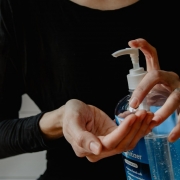
But before you start, it’s crucial that you understand simply rubbing your paws with hand sanitizer is not a substitute for good ol’ hand washing). Alcohol-based disinfectants used in the right amount (3 milliliters) and rubbed long enough (25 to 30 seconds) are fine in a pinch, because you’re not always near a sink. But soap, water, and a good scrub is the absolute best way to protect yourself against contagious diseases. Got it? Good. Let’s do this.

Stats

Time: literally 2 minutes

Estimated ingredient cost: $15 (makes 3.5 cups, or 15 of those little two-ounce bottles)

Difficulty: easy

Tools

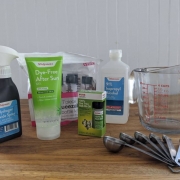
  • Measuring cup
  • Measuring spoons
  • Whisk
  • Empty spray bottles (for WHO formulation)
  • Empty lotion or sanitizer containers (for gel formulation)

Instructions for the WHO formulation

Ingredients

  • 1 cup of 99% isopropyl alcohol
  • 1 tablespoon of 3% hydrogen peroxide
  • 1 teaspoon of 98% glycerin
  • ¼ cup, 1 tablespoon, and 1 teaspoon (or 85 milliliters) of sterile distilled or boiled cold water

The WHO has a comprehensive guide on how to make your own hand sanitizer—the only problem is that if you follow these instructions, you’ll end up with a lot of it. Like, exactly 2.6 gallons of it. If you want to make enough to last you, your family, and all your friends through a zombie apocalypse, you definitely can. But if you want to keep things on a smaller scale, we’ve adapted the measurements for you.

1. Pour the alcohol into a medium-sized container with a pouring spout. The percentages on the labels of isopropyl alcohol refer to the alcohol concentration in them. You’re dealing with almost pure alcohol if you’ve got 99.8%, whereas 70% means the bottle is only a little more than two-thirds alcohol, and the rest is water.

  • Note: Some formulations have tried to adapt these proportions to use 91% isopropyl alcohol or even 70%. But these alcohol concentrations will render a final product that doesn’t comply with the Centers for Disease Control and Prevention’s recommendation of using hand sanitizers with at least 60% alcohol to fight COVID-19.
A measuring cup will help you get all proportions right.
. Popular Science

2. Add the hydrogen peroxide.

3. Add the glycerin and stir. This ingredient is thicker than both alcohol and hydrogen peroxide, so it’ll take some stirring to combine everything. You can use a clean spoon for this or, if your container has a lid, you can put that on and shake it well.

4. Measure and pour in the water. If you’re using 99% isopropyl alcohol, you’ll need to measure ¼ of a cup, 1 tablespoon, and 1 teaspoon of distilled or boiled cold water and add it all to your mix. If you’re using another percentage of isopropyl alcohol, just pour as much water as necessary to get to a final volume of 345 milliliters, or approximately 1.4 cups. Stir.

5. Sanitize your spray bottles and pour in your hand sanitizer. Spray some of your leftover alcohol into your bottles and let them sit until the alcohol has evaporated. Pour in your sanitizer.

6. Label your bottles. You don’t want any accidents where you or anybody else ingests your newly made hand sanitizer. Take the time to label your bottles. Go kill some germs.

Instructions for gel sanitizer

Always label your bottles. It's unlikely you'll mistake one of these for a flask, but accidents do happen.
. Popular Science

Ingredients

1. Pour the alcohol into a medium container with a pouring spout. Some recipes online use vodka instead of isopropyl alcohol, but most vodkas don’t contain a high enough percentage of alcohol to be effective.

  • Note: Using isopropyl alcohol diluted beyond 91% will result in a more weaker hand sanitizer that doesn’t meet the CDC’s 60% benchmark.

2. Measure and pour the aloe vera gel. Alcohol can be hard on your skin, so using aloe is a good way to counteract that effect and keep your hands smooth. If you want to keep things natural, you can use aloe vera gel straight from the plant without worrying about it going bad—the alcohol will act as a preservative. However, you will need to keep in mind that natural aloe gel is thicker than its store-bought counterpart and will thus affect the final product differently—it will make your hand sanitizer more sticky, which means you’ll need to rub your hands more times for it to fully absorb.

That is a lot of aloe vera gel.
. Popular Science

3. Add the essential oil. Tea tree oil is naturally antibacterial, so it makes sense to use it here. But if you’re not a fan of its smell, you can use another type of essential oil, like lavender, lemongrass, or eucalyptus.

4. Whisk. To fully mix all ingredients, stirring won’t be enough. Get a whisk and beat that hand sanitizer into an homogeneous gel.

Shake that sanitizer like a Polaroid picture.
. Popular Science

5. Sanitize your spray bottles and pour in your hand sanitizer. Spray some of your leftover alcohol into your bottles and let them sit until the alcohol has evaporated. Pour in your sanitizer.

6. Label your containers. You don’t want any accidents where you or anybody else ingests your newly made hand sanitizer. Take the time to label your bottles. Continue living.

Written by Sandra Gutierrez G. for Popular Science and legally licensed through the Matcha publisher network. Please direct all licensing questions to legal@getmatcha.com.